Last Call for Canadian News
/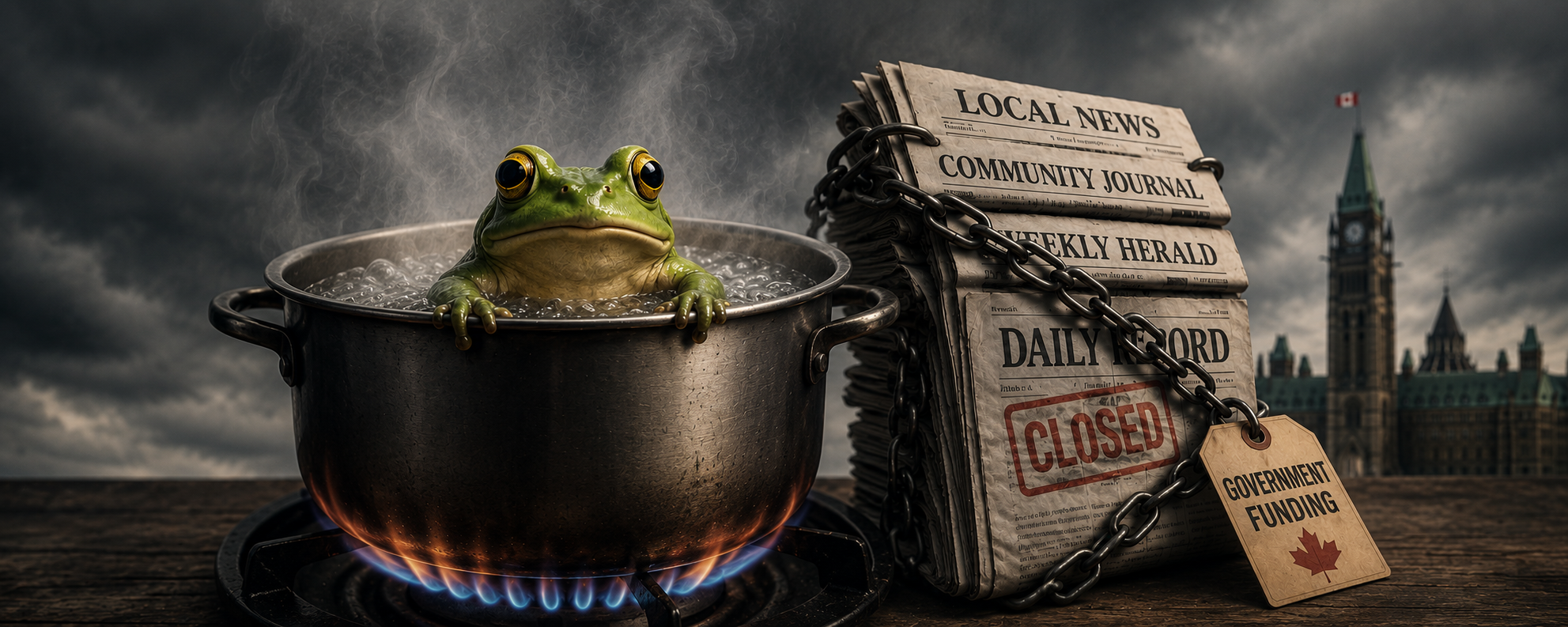
Canadian journalism isn't dying in a single blow. It's being cooked by degrees.
I sold my first newspaper article to The Sault Star in my hometown of Sault Ste. Marie, Ontario when I was in my teens. I still remember the thrill. Not the small cheque, although that was a pleasant surprise, but the realization that words assembled with care and skill could be worth something to others. Years later, that spark would send me to Journalism school, to jobs in print and broadcast media and, ultimately, more than three decades in media relations. I've observed the Canadian media from many angles over the years and I'm telling you that something has gone very wrong, slowly enough that most Canadians haven't noticed it.
We all know the analogy of the frog in the pot of water. The temperature rises just slowly enough so that no single moment feels like the right time to jump. Ultimately, things end badly for the frog. This is the most appropriate analogy I can think of to describe what's happened to the media in Canada over the past several decades, having morphed from an largely independent institution into one that is increasingly reliant on government funding. There's no singular scandal at play here. No smoking gun. Instead, there's a long series of incremental steps whose cumulative effect none of us were asked to approve.
The collapse of the old arrangement
For most of the twentieth century, the news business ran on a tried-and-true arrangement. Advertisers wanted eyeballs and ears and newspapers and broadcasters had them. Money flowed from the first to the second and journalism was the thing that happened in the space that money paid for.
That arrangement is largely broken today. It didn't end with a bang. It melted like a Sault Ste. Marie snowbank in May. As classified and display advertising migrated online, the overwhelming share of digital ad spending was captured by two companies: Google and Facebook. Together, the two tech giants vacuumed up roughly 80% of the $12.6 billion Canadian online advertising market, while newspapers' share of total Canadian advertising revenue fell from 83% in 2010 to 54% in 2022.
The consequences of this shift arrived, not as a thunderclap, but as a long, slow decline. Between 2008 and October 2025, 603 local news outlets closed across 388 Canadian communities, the majority of them being community newspapers. Today, about 2.5 million Canadians now live in a postal code served by one or zero local news outlets (that's double the proportion of 15 years earlier), even as the national population grew by approximately eight million people. About half of those closures happened in communities of 20,000 people or fewer, the small towns where the weekly paper was frequently the only institution paying a reporter to sit through a council meeting. Newspaper operating revenues fell to $1.6 billion in 2024, down nearly 18% from 2022.
In isolation, each of these losses was easy enough to absorb. A weekly newspaper in northern Manitoba folds. Sure, it's a sad story but it's a local one. Another degree of heat in the pot. A regional chain restructures under bankruptcy protection and goes digital-only. Another degree. The Guelph Mercury… The Nanaimo Daily News… The Moose Jaw Times-Herald… The Halifax Daily News… The list goes on. No single closure signals a catastrophe. It's only when you zoom out that the scale comes into focus.
The government moves in
Faced with an industry in distress, the Canadian government decided to step in. I should be measured here, since I don't know the people who designed these programs and I won't presume to know whether their motives were benign or political. What we can observe, however, is the structure they've built and the position that it has left all Canadians in. And it's that structure that matters most, regardless of intent.
The interventions came one at a time, each with their own justification. In 2019, there was a package of tax measures worth about $595 million (commonly referred to as the newspaper bailout). During the pandemic, there were emergency wage subsidies and special top-ups for journalism. Then, a Local Journalism Initiative designed to fund reporters in underserved areas. A Canada Periodical Fund for magazines and community papers. A Canadian Journalism Labour Tax Credit to directly defray the cost of employing journalists.
Then came the Online News Act (Bill C-18), based upon the idea that the technology giants profiting from the news should pay for it. Meta's response was to block Canadian news on its platforms entirely, depriving outlets of audience and deepening the very crisis the law was meant to cure. Google settled for a hundred million dollars a year. And the government, having helped engineer the shortfall, moved to fill it: the labour tax credit was expanded to cover 35% of journalists' salary costs up to a far higher cap, raising the per-employee support by well over 100%.
Add it all together and the picture is stark. Between the support programs (the Periodical Fund, the labour tax credit, the Local Journalism Initiative) and the roughly $1.4 billion annual appropriation to the CBC, the federal government now spends well over $1.7 billion a year underwriting Canadian journalism. To put that number in perspective, that's more than the government spends annually on the Canada Disability Benefit. At the level of the individual newsroom, the reach is just as striking: the labour tax credit alone can cover up to 35% of an eligible journalist's salary costs, to a cap of $29,750 per employee. That sits atop the other federal supports and the Online News Act money flowing into the sector.
There was never a single day on which Canadians were asked: "Do you want a press whose salaries are underwritten, in significant part, by the government that the press exists to hold accountable?" Had the question been asked in that manner, one might suspect the answer would have been a resounding 'no'. Instead, it came in increments, each defensible on its own, but with the cumulative effect being transformative.
The other erosion: the craft itself
There is a second decline running alongside the financial one and because I spend my working life training people to face the media, I see it from a unique vantage point. To be fair, I do believe the vast majority of people enter journalism for good reasons. They want to tell stories. They want to find things out, get the facts right and make a positive difference in their communities and their country.
But something has changed in the profession of journalism and I hear it constantly from clients across the country. They talk about interactions and interviews with reporters who haven’t done their homework, who don’t grasp the basic substance of the stories they’re covering, who are emailing questions clearly generated by ChatGPT. Perhaps the more troubling story revolves around the number of clients I speak to in a given year who are grappling with a contentious issue, who brace themselves for that expected call from the media and then realize weeks later that the call never came. A decade ago, that call would have been unavoidable. Today, there aren’t enough reporters, enough hours or enough bandwidth to make all those calls. And a story no journalist calls about is a story Canadians never see. Extrapolate that across the country and the result is a public that’s going quietly blind to a great deal of what is being done in its name.
So, yes, the institutional memory of Canada's press has thinned. The veteran reporter who knew how a budget actually worked, who could smell when a press release was hiding something, who had covered the same beat long enough to catch a politician in a shifting story…that person was expensive. And in a contracting industry, expensive people are the first ones to go. What remains are people who are often younger, greener, more precariously employed and more dependent on the institution's goodwill to keep their jobs. The decline in the sum total of journalistic experience and judgment is not a failing of these individuals. It's what happens to a profession when the economic floor falls out from under it.
How dependence actually works
The obvious objection is that public funding need not corrupt. Many subsidized journalists would bristle at the suggestion that a tax credit has bought their silence and they would be right to do so. Institutional incentives don't have to operate through bribery. They can also operate through the slow shaping of what feels normal, what feels safe or what feels like a story worth the institutional risk. When a significant share of an industry's labour costs depends on the continued goodwill of the state, no one needs to issue a directive. You only need a thousand of these small calculations about which investigations are worth the trouble, which ministers are worth antagonizing, which questions are worth asking the Prime Minister or which framings will read as responsible and which will read as conspiracy theories.
Analysts at think tanks across the spectrum (from the Macdonald-Laurier Institute to the Fraser Institute and the internet-law scholar Michael Geist) have flagged the same structural worry: a press that is increasingly reluctant to scrutinize the subsidy regime keeping it alive.
Trust didn’t collapse overnight. It leaked away over a generation. The longest continuous measure we have is from the United States. Gallup has asked the same question since the 1970s, when, following the Watergate scandal, roughly seven in 10 people said they trusted the media to report the news fairly. That figure slipped below a majority for good by 2007 and reached a record low of 28% in 2025. A profession once believed in by two-thirds of the public is now doubted by nearly three-quarters. Canada's own tracking began later but traces the same descent. A fall of almost 20 points since 2018, leaving barely a third of Canadians willing to say they trust the news most of the time. In a democracy, this is not a minor cultural shift but, rather, a structural warning. Self-government rests on a shared body of fact that citizens broadly accept as legitimate. When that common ground erodes, so does the public's ability to deliberate, to judge those in power and to agree on what is even being argued about.
Even as trust has eroded, Canadians continue to tell pollsters (overwhelmingly, some 87% in one survey) that local journalism is important to a functioning democracy. Into the vacuum rushes everything you would expect: algorithmic outrage, partisan Substacks, foreign disinformation. A population that no longer trusts the mainstream media and no longer has a local newspaper covering the council meeting does not become better informed. It becomes differently misinformed and, ultimately, more isolated with its grievances.
What the silence makes possible
Here's why all of this matters beyond the newsroom and the potential danger that it is setting us up for.
A government that faces a confident, independent, adversarial press is invariably a constrained government. It's a government that must explain itself. It must anticipate scrutiny and assume that overreach will be exposed. If you remove that press or, more precisely, replace it with one that is financially beholden to the very government it covers, that constraint dissolves. The Overton window of what can be asked, challenged and resisted shrinks. Not necessarily because anyone declared it so, but because the institution that used to hold the window open has lost the strength, experience and independence to do so.
Consider what happened to Tina Yazdani. For more than seven years, she covered Queen's Park for CityNews with what colleagues called a 'tough-but-fair' reputation (the highest praise a journalist can receive, by the way), even winning an award for her health-care reporting. She had been pressing the Ford government hard on education policy and the movement of billions of dollars in public funds. In April 2026, she was abruptly fired. Within days, at least two of her stories that were critical of the Ford government apparently vanished from the CityNews website without public explanation. I'm not in a position to declare a causal link and her former employer disputes her account, citing internal policy breaches. But step back and look at the sequence of events. A veteran reporter produces pointed coverage of the government, the stories disappear and she's gone within days. The timing invites a question that ought to trouble anyone who cares about a free press. Yazdani has since been hired by a digital outlet where she continues to work on the same kind of stories she was doing before. She's also suing her former employer for $650,000. Her work did not stop being possible. It just stopped being possible for her at CityNews.
That's the pattern in miniature. And it's the kind of condition under which a government grows bold enough to reach for the next set of tools, which is what is happening now. Across the country, we see a mounting appetite for online age-verification and identity requirements for new categories of regulated 'harmful' speech, for the machinery of digital censorship, much of it advanced under the banner of protecting children. I'm sure some of the politicians pushing for these measures actually believe in them. But many experts have warned that the child-protection framing functions, in significant part, as smoke and mirrors. An emotionally unanswerable justification wrapped around a vast expansion of the state's power to monitor and control what citizens say and read online.
A robust, independent press is exactly what would interrogate such measures. They would ask who gets to define harm. They would track how surveillance powers are actually used once granted. They would refuse to accept 'for the children' as the end of the conversation rather than the beginning. A press that has been hollowed out financially, thinned of experienced judgment and made dependent on government money is far less likely to mount that interrogation with any force. The deterioration of the Canadian media and the expansion of state control over speech are not two separate stories. They're connected. And the first made room for the second.
George Orwell wrote that, "If liberty means anything at all, it means the right to tell people what they do not want to hear." A free society needs institutions strong and independent enough to keep telling governments what they do not want to hear. We're in danger of losing ours. Not to a coup, but to a slow administrative warming that we didn't vote for and were never asked to accept.
What is to be done
There's no simple solution to this dilemma. The economic forces that destroyed the old advertising model of the Canadian media are real and largely irreversible. The communities losing their newspapers need something to replace them. But the answer can't be a press kept alive on the goodwill of the state, because that cure attacks the very independence that made the press worth saving in the first place.
There are reasons for guarded optimism. New, independent outlets are emerging, lean and adversarial and unencumbered by legacy dependence. A genuine rebirth of strong community journalism may yet be in our future, built on subscriptions and trust rather than subsidies. But that is a longer-term project and, unfortunately, it won't arrive in time to fight the immediate battle.
The immediate battle is over speech itself. While we work to rebuild a press worthy of the name, Canadians have to do everything in their power to protect their freedom of expression online. To refuse the easy trade of liberty for the promise of safety, to insist that 'for the children' is examined rather than accepted and to recognize the identity-and-censorship agenda for the expansion of power it is. The water has been warming for a while now, by such small degrees that comfort and danger have become hard to tell apart. The difference between us and the frog is that we can still feel it. The only question is whether we will climb out while we still can.