What You Do to the People You Fire Says Everything to the People You Keep
/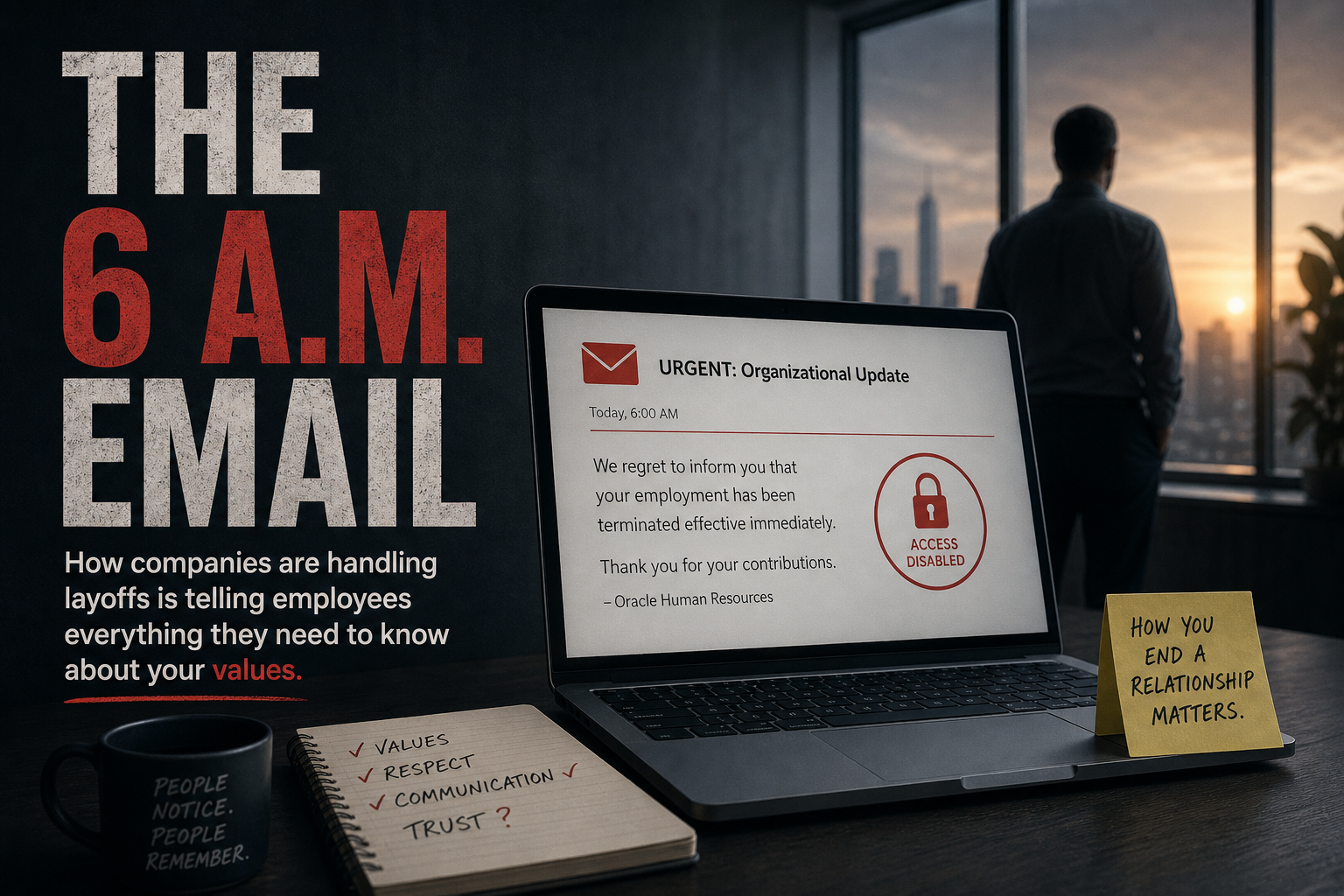
The 6 a.m. Email
Oracle laid off up to 30,000 people on April 1st of this year. Employees across the US, India, Canada and Latin America woke up to find an email had arrived early that morning. Their computer access was already gone before they'd read it.
That's how you find out you no longer have a job after years (in some cases decades) of service to one of the world's most profitable technology companies.
This Is Becoming the Norm
Oracle isn't an outlier. Block laid off 40 percent of its workforce in February (about 4,000 people) citing AI as the reason. Jack Dorsey announced it publicly on X before many employees had been personally notified. Snap cut 16 percent of its staff. Amazon let go of up to 30,000 corporate employees over recent months. The method in most cases: an email, a severed login and silence.
These are not small companies with limited HR resources. These are some of the most profitable organizations in human history. The choice to communicate this way wasn't a resource constraint. It was a decision.
The Calculation
I co-host a podcast called Reputation Town with John Perenack. When we discussed this recently, John made a point that's stuck with me. These companies have probably done the math. The bad press lasts 13 hours. The news cycle moves on. Nobody's going to cancel their Amazon Prime account because of how the layoffs were handled.
They might even be right.
But the math has a variable they're not counting.
Who's Watching
When you lay someone off at 6 a.m. via email, you're not just communicating with the person you're letting go. You're communicating with every person who's still there.
You're showing them exactly what kind of organization they work for. You're telling them what they can expect if their number ever comes up. You're answering, in the clearest possible terms, the question every employee is always quietly asking: does this place actually value me?
The best people (the ones with options, the ones competitors are already calling) notice this. And they act accordingly. Sometimes immediately. More often six months later, when a better offer arrives and they find it very easy to say yes.
That's the real cost. Not the press coverage. Not the LinkedIn posts from affected employees. The quiet exit of people who weren't on the list but decided they didn't want to be around for the next one.
Layoffs Are a Communications Event
I've spent three decades preparing executives and spokespeople to communicate clearly, credibly and with integrity under pressure. Layoffs are one of the most consequential communications events an organization will ever face. Not because of the press release or the media coverage, but because of the signal they send to the people inside.
How you treat the people you let go is a direct statement of your values. And your values are never more visible than when things are hard.
A 6 a.m. email is efficient. It might even be legally defensible. But it sure ain’t a communications strategy. Unfortunately, it's what happens when you stop thinking about communication at all.
The organizations that handle these moments well understand something simple: how you end a relationship matters as much as how you built it. And the people who watched you end it will remember exactly what they saw.