Vrabel Called the Letterman Play
/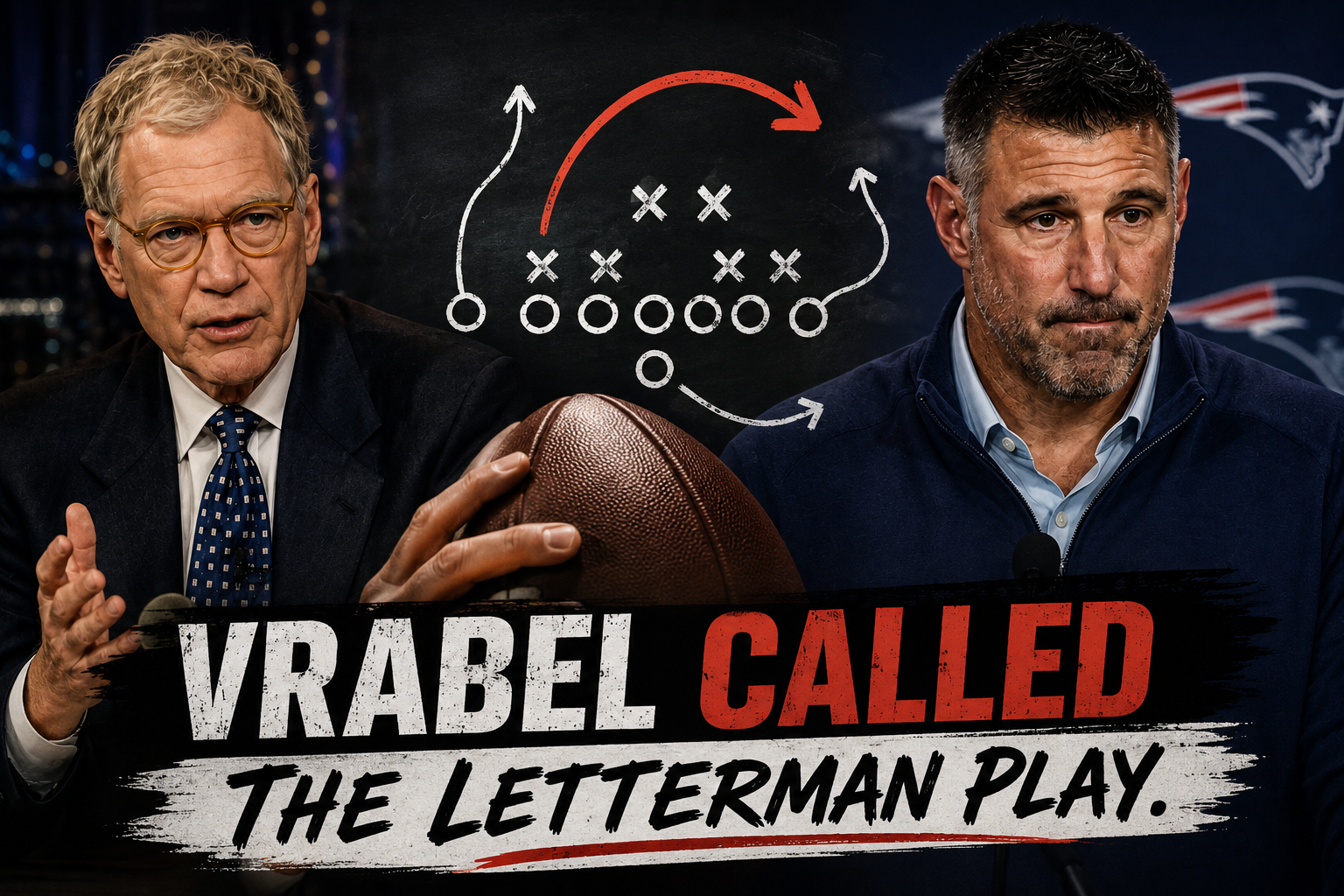
Seventeen years separate two of the more unusual public statements in the history of crisis comms. One was behind a late night desk. The other in front of a wall of NFL sponsor logos. Both men facing questions about their personal conduct. Both attempting to close the matter with a prepared statement. One of them succeeded.
Whether someone in Vrabel's camp pulled up the David Letterman clip from 2009 and said ‘this is our play’ is impossible to know. But the similarities are close enough that coincidence feels like a stretch.
What David Letterman Actually Did
On October 1, 2009, David Letterman walked onto the Late Show stage and told his audience he had been the target of an extortion attempt.
A CBS News producer named Robert Halderman had discovered evidence of Letterman's relationships with female staffers and demanded $2 million to stay quiet. Letterman went to the Manhattan District Attorney's office, cooperated with investigators, handed Halderman a phony $2 million cheque and watched him get arrested that same morning.
That evening Letterman told his audience the whole story himself. The same day as the arrest. Before anyone else could frame it.
His full monologue ran nearly ten minutes that night. For the first seven or eight, he told a gripping story about a mysterious package in the back of his car at six in the morning, a threatening letter, a sting operation and an arrest. By the time he got to the admission, his audience had been on a journey with him. He had framed himself as the target of a crime before he framed himself as someone who had done something wrong. That sequencing was not accidental.
When the confession came, it landed on a silent room. "I have had sex with women who work for me on this show. My response to that is: yes, I have." He was careful to say the women involved had their own decisions to make about coming forward.
Then the audience laughed. The kind of laugh that happens when a room doesn't quite know what to do with information it just received. Letterman read it immediately. "I know what you're saying. I'll be darned, Dave's had sex. That's what the grand jury said also." The room found its footing. He brought the audience back into their normal relationship with him and said that’s the last he would publicly say about the matter. He closed the door.
The next week, Letterman’s ratings went up 19%. CBS issued one sentence: his comments speak for themselves.
What Vrabel Did Instead
For context, New England Patriots head coach Mike Vrabel spent several weeks at the centre of persistent and increasingly documented speculation about a personal relationship with ESPN NFL reporter Dianna Russini. Photos emerged in multiple locations. Eyewitness accounts surfaced. The story wasn't going away. On April 21, 2026, Vrabel stepped in front of cameras to address it.
There are two distinct issues with how he handled the situation. The first happened before he said a word.
For weeks, there was nothing from him. And into that silence poured everything else. Photos. Eyewitness accounts. New locations. Each new development gave social media new content and gave media outlets a fresh reason to run the story again. The vacuum became the story's oxygen supply.
The history of high-profile personal scandals is full of cautionary tales about what silence produces. Tiger Woods said nothing for 84 days after his story broke in November 2009. By the time he did his tearful press conference, the story had consumed his sponsorships, his marriage and battered his public image. Instead of protecting him, silence gave the story room to grow into something far larger than the original incident. A vacuum will always be filled by someone else.
Vrabel wasn’t silent for 84 days. But he kept his head down long enough for competing narratives to take hold, for speculation to morph into assumption and for the photos to keep popping up. By the time he stepped in front of cameras, he wasn’t breaking the story. He was responding to a version of it that had already been written by other people.
That’s the most fundamental difference between what he did and what Letterman did. Letterman's audience heard the story for the first time from him. He controlled every element of the first impression (the framing, the sequence, the tone and the closing). There was no competing version to push back against. Just him and his audience and a story nobody else had heard yet.
Vrabel had none of that. His statement was not an opening move. It was a response to a game that was well underway.
Which brings us to the second problem…what he actually said.
The first word of his statement was “Again…”. The choice of that word (in my opinion) was to imply we were somewhere in the middle of an ongoing conversation when, in reality, there had been no previous public conversation at all. From there, it wandered. He spoke about accountability without specifying what he was being accountable for. He referenced ‘previous actions’ without describing them. He mentioned a distraction ‘to the people I care most about’ without identifying what the distraction was. He used the phrase ‘the best version of me’ twice. Accountability language assembled in roughly the right order but attached to nothing of substance.
Then, there was the body language. Shifting weight. Limited eye contact. A man who clearly didn’t want to be standing there.
He then attempted, as Letterman had done, to close the door. Out of respect for his family, he stated there would be no further comments.
But the door doesn’t close just because you say it does. Letterman could make that declaration credibly because he had confessed the mess. There were no unanswered questions on the other side. Vrabel made the same declaration while the central question remained entirely untouched.
Here’s the core of the problem. Once you decide to break your silence, you have to go all the way. A half-measure is worse than either extreme. Say everything, address the elephant directly and close the door properly or say nothing at all and let the story find its own end. What Vrabel did was neither. He broke his silence without saying anything meaningful, which gave the story a new headline without giving it a conclusion. Every outlet that had been covering it had a legitimate reason to run it again with a fresh angle attached.
Why It Might Not Matter
And here is where 2026 is a very different world from 2009. Investigative newsrooms have been hollowed out. The volume of content competing for attention at any given moment is staggering. Scandals that would have defined careers 10 years ago now struggle to survive a single news cycle. In that environment, running out the clock sometimes works as well as doing it right.
Which raises an obvious question: if that's true, why did this particular story drag on for weeks?
Because it kept getting new fuel. It wasn't one story that refused to die. It was a series of new disclosures, each one resetting the clock. New photos. New locations. New accounts. Every fresh development gave outlets a reason to run it again. Without that ongoing supply of new material the story would have faded on its own, as most do now.
Which is precisely why Vrabel's statement was a miscalculation. It was, itself, another log on the fire.
The most effective play would have been the Letterman approach. Address the story head-on in the first 24 hours. Address the elephant in the room, close the door and give the story a proper ending. That option closed when more photos started appearing.
The second most effective play would have been to say nothing and let the story exhaust its own fuel supply. That’s what podcaster and neuroscientist Andrew Huberman did when a lengthy magazine profile detailing his personal life generated significant attention. He said nothing publicly, kept producing his content and the story lost oxygen within days.
What Vrabel did was a bit of both. He broke his silence without saying anything meaningful, which gave the story a new headline without giving it a conclusion. In crisis communications, that’s essentially a half-measure that satisfies nobody and keeps the story alive without resolving it.
Vrabel called the Letterman play but couldn't execute it. The better options were always at either end of the spectrum. He picked the middle. And the middle, in situations like this, is where stories go to keep living.
As for what it says about the state of media accountability in 2026, that’s a conversation for another day.