The Most Obvious Question in the Room
/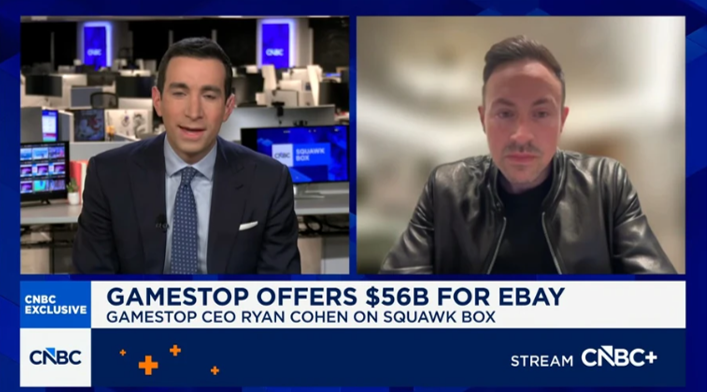
By now, most people in the business world have seen or heard about GameStop CEO Ryan Cohen's CNBC appearance this week, in which he attempted to defend his company's $56 billion bid to acquire eBay. The interview didn’t go well. There were long, uncomfortable silences. There were dismissive responses to legitimate questions. When pressed repeatedly about a perceived gap in financing for the deal, Cohen told one of the anchors he didn't understand her question and directed viewers to the company website. The stock dropped 10%. It became a meme by midday.
To be fair, two alternative interpretations are worth acknowledging. Some of Cohen's supporters in the GameStop community saw the interview as an act of defiance. A refusal to play by Wall Street's rules. And a small number of observers have floated the theory that the awkwardness was intentional, a kind of strategic ambiguity designed to keep the market guessing. I don't subscribe to either of those interpretations, but they’re worth mentioning.
What I do think is worth discussing is what this interview illustrates for anyone who has to defend a high-stakes position in front of a camera.
A media interview of this magnitude isn’t a scripted interaction. In the aftermath, some of Cohen's supporters posted on X that CNBC had blindsided him by asking different questions than the ones they said they would ask him. Maybe that's true. But a CEO defending a $56 billion acquisition bid on national TV should be prepared to answer any question a journalist might reasonably ask. And the question of how you intend to pay for the deal wasn't a tough question. It was the most obvious question in the room.
I doubt Cohen has lost any sleep over this interview. But that doesn’t change the fact that it was a lost opportunity. A CEO is making a moonshot bid for a company four times the size of his own and he’s going on a prominent business program to explain it. That’s a huge opportunity. Getting ahead of the financing question and using the interview to lay out a compelling vision for the deal would have led to a more successful media relations outcome.
For any executive preparing for a high-profile media appearance, the lesson isn't that the questions will be friendly or that the format will be comfortable. The lesson is that the most important questions are often the most predictable ones. And smart preparation is what allows you to meet them with mic-drop answers rather than silence.